Trauma map
Every target, on one map.
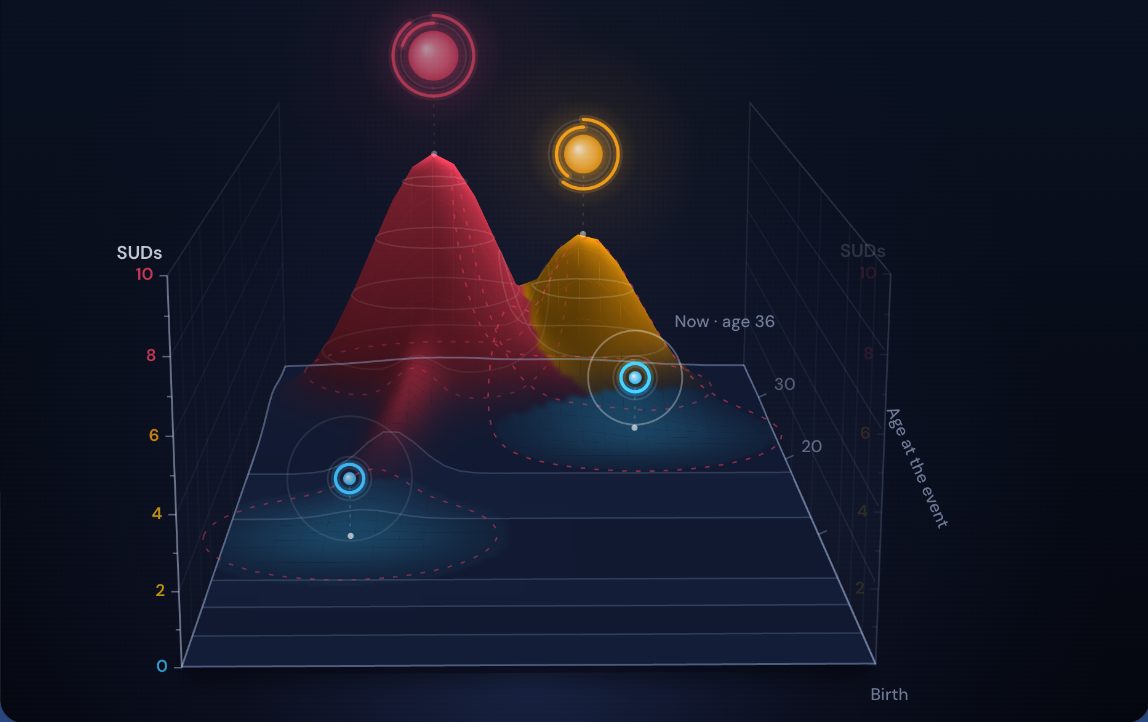
intuitiveEMDR keeps each client's targets on one map. Each memory sits at the client's age at the event, on a floor that runs from birth to now, and rises to its SUDs now in that reading's colour. Rings beside it show its VOC and the SUDs it started at. The map is drawn from the targets you record, so when you work a target in session, the map changes with it.
What you see
The map sits at the top of the client's Targets tab. Each target is a peak. Its height and colour are its SUDs now, on the five-colour scale from rose at 8 to 10 down to sky blue at 0. An outer ring shows SUDs, an inner ring VOC, and a dashed ring the SUDs you recorded when you set the target up.
A reading that was never taken is drawn in grey. Nothing is filled in for it.
Where each target sits
A target sits at the client's age at the event. Given an age range, it sits at the middle of the range. Given only a developmental stage, it sits at that stage and says the age was not recorded.
The floor can be marked out by developmental stage: Erikson's, by default, or Freud's, Piaget's or Bowlby's, by decade, or not at all.
Reading the map
The map is a 3D view you can move around in.
- View it from the front, the side or the top, turn it, zoom in and out, or open it full screen.
- Filter it by negative cognition, by emotion, or by cluster once you have named one.
- Targets you link on a target's page are drawn joined.
- Click a target for its card: its image, negative and positive cognitions, emotions, body sensations, SUDs and VOC, and a link to the full target.
From the map to the plan
Each target can carry its prong, past, present or future, and a cluster name you choose. The client's Plan tab reads both: its three-pronged target plan lists each target under its prong, and its clusters and themes group targets by cluster. In an R-TEP session, the episode becomes a past-prong cluster named after it.
A target is complete when a session closes it at SUDs 0, or at 1 you mark as ecologically valid, and VOC 10. The plan counts those targets from the record each time it opens.
What it does not do
- It does not decide the order you work targets in. The sequence is your clinical judgement.
- It shows only what you have recorded. A target with no reading yet is drawn in grey.
- Your client does not see it. The map is part of your record.
Questions
What is an EMDR target map?
A picture of a client's targets together: when each memory happened, how disturbing it is now, and which targets belong together. In intuitiveEMDR it is drawn from the targets you record, so it stays current through treatment.
How is each target placed on the map?
At the client's age at the event, on a floor from birth to now. An age range places it at the middle; a developmental stage alone places it at that stage, marked as having no recorded age.
When does a target count as complete?
When a session closes it at SUDs 0, or at 1 you mark as ecologically valid, and VOC 10. Otherwise it stays in processing, and its peak shows where it stands.
Can I group targets into clusters and prongs?
Yes. Give targets the same cluster name and filter the map by it. Set each target's prong, past, present or future, on the target itself. The Plan tab lists targets by prong and groups them by cluster.
Does the client see the map?
No. The map is part of your record.
Is the map on the free plan?
Yes. The trauma map is on every plan, the free plan included.
Read next
A target list that stays live.
Add a client's first target and watch the map take shape as you work. The free plan needs no credit card and has no time limit.
Create a free account